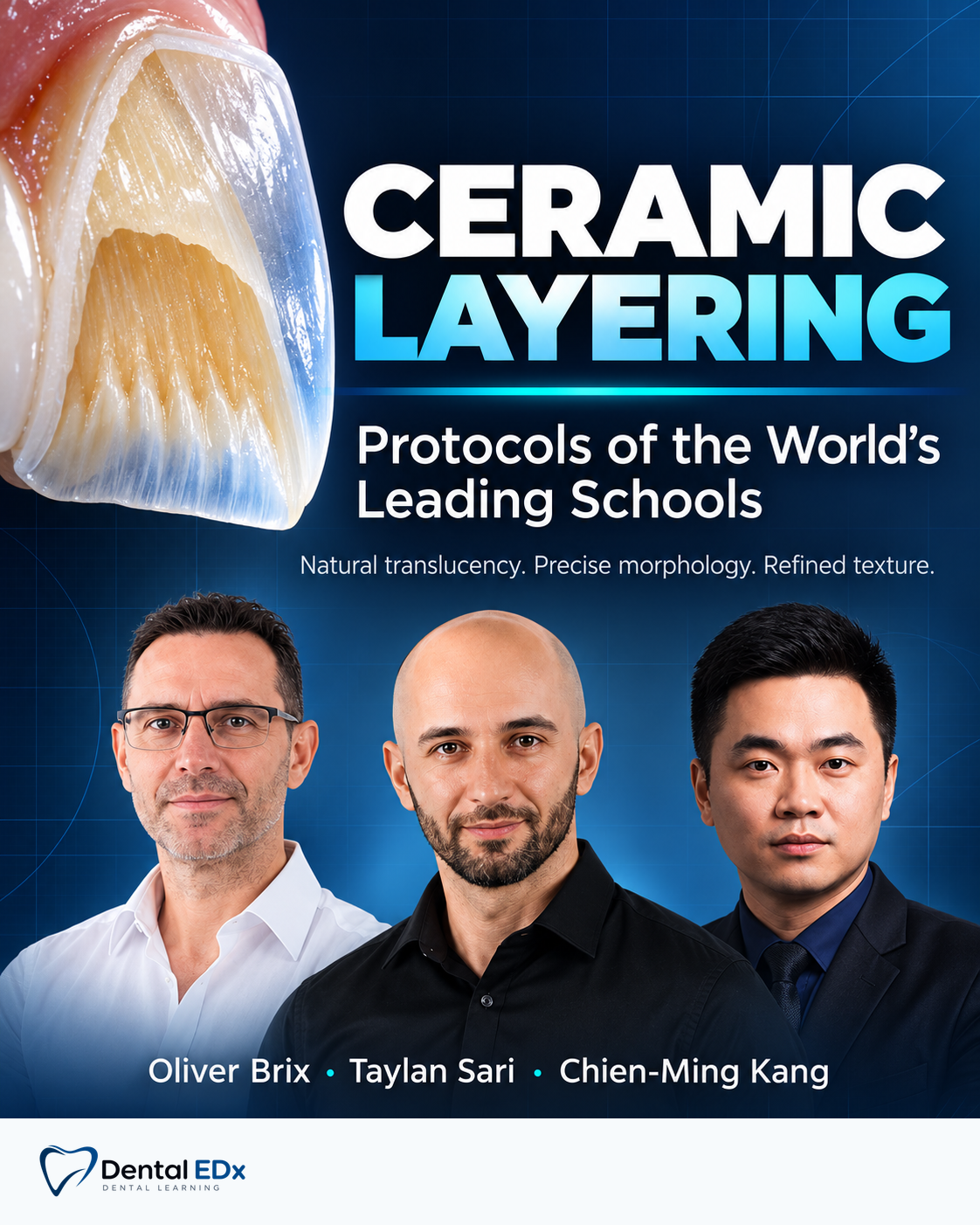

Educational scope. This article supports professional learning and case discussion. It is not patient-specific advice, a clinical protocol or a substitute for supervised training.
A ceramic layering demonstration is easier to understand when each addition has a stated purpose. Instead of collecting product names, identify what the ceramist is trying to reproduce and how the available restorative space shapes that decision.
CLINICAL TAKEAWAY
What matters most
- Define the optical target.
- Name the purpose of each stage.
- Use consistent comparison conditions.
EVIDENCE LENS
ADA guidance recognizes a range of indirect ceramic materials; material-specific handling remains essential when translating a layering demonstration into practice.
Describe the visual target
Use a reference that identifies form and visible optical characteristics rather than relying only on a shade code. Ask which observations are specific to this tooth and which reflect the chosen material system. The target should guide the demonstration, not be reconstructed after the layers are complete.
Watch the sequence with a question
At each stage, ask what is being built, what space remains and what will be evaluated after processing. Avoid transferring the exact sequence to a different system without checking compatibility. An educational demonstration can explain an approach without proving that every product combination is interchangeable.
Evaluate the result under consistent conditions
Compare like with like when reviewing photographs. Different lighting or image editing can make a surface appear to change independently of the restoration. Keep the communication between clinician and ceramist in the record so that later revisions respond to a defined concern.
Layering begins with a visual diagnosis
Before selecting powders or masses, describe value, chroma, translucency, internal effects and surface behavior in the neighboring dentition. The build-up then becomes a response to observed optical goals rather than a memorized sequence.
Evaluate the result under more than one condition
A restoration can change under different illumination, backgrounds and levels of hydration. Training should distinguish internal layering corrections from morphology, texture and glazing decisions made nearer the surface.
Turn the topic into a structured team review
Choose one de-identified case that raises the question of ceramic layering techniques. Review it in stages rather than jumping to the final image: define the patient-centered objective, list the available records, identify who made each decision and mark every assumption or missing item. Then compare the sequence with the cited evidence and the applicable manufacturer or professional guidance. The objective is to understand why this pathway was selected, not to reproduce a technique from an article.
Repeat the review after delivery or follow-up and ask what the team would change. Use these checkpoints: Define the optical target. Name the purpose of each stage. Use consistent comparison conditions. Record disagreements between the clinical, technical and maintenance perspectives instead of forcing an immediate consensus. A short, documented calibration exercise makes the article useful to the whole team and creates questions that can be taken into formal education, mentoring or supervised practice.
TAKE INTO YOUR NEXT CASE DISCUSSION
Three points to keep in view
- Define the optical target.
- Name the purpose of each stage.
- Use consistent comparison conditions.
Evidence & references
ADA guidance recognizes a range of indirect ceramic materials; material-specific handling remains essential when translating a layering demonstration into practice.
- Materials for Indirect Restorations American Dental Association
References support the evidence discussion, not an endorsement of DentalEDX. Practical study prompts are editorial suggestions. No patient outcomes or professional accreditation are promised.
A common question
Will more layers always create a more natural result?
No. Complexity is not an outcome measure; the sequence should serve the defined restoration and material system.
CONTINUE LEARNING
Explore this topic in more depth.
Review the curriculum and prerequisites to choose teaching that fits your experience.