Educational scope. This article supports professional learning and case discussion. It is not patient-specific advice, a clinical protocol or a substitute for supervised training.
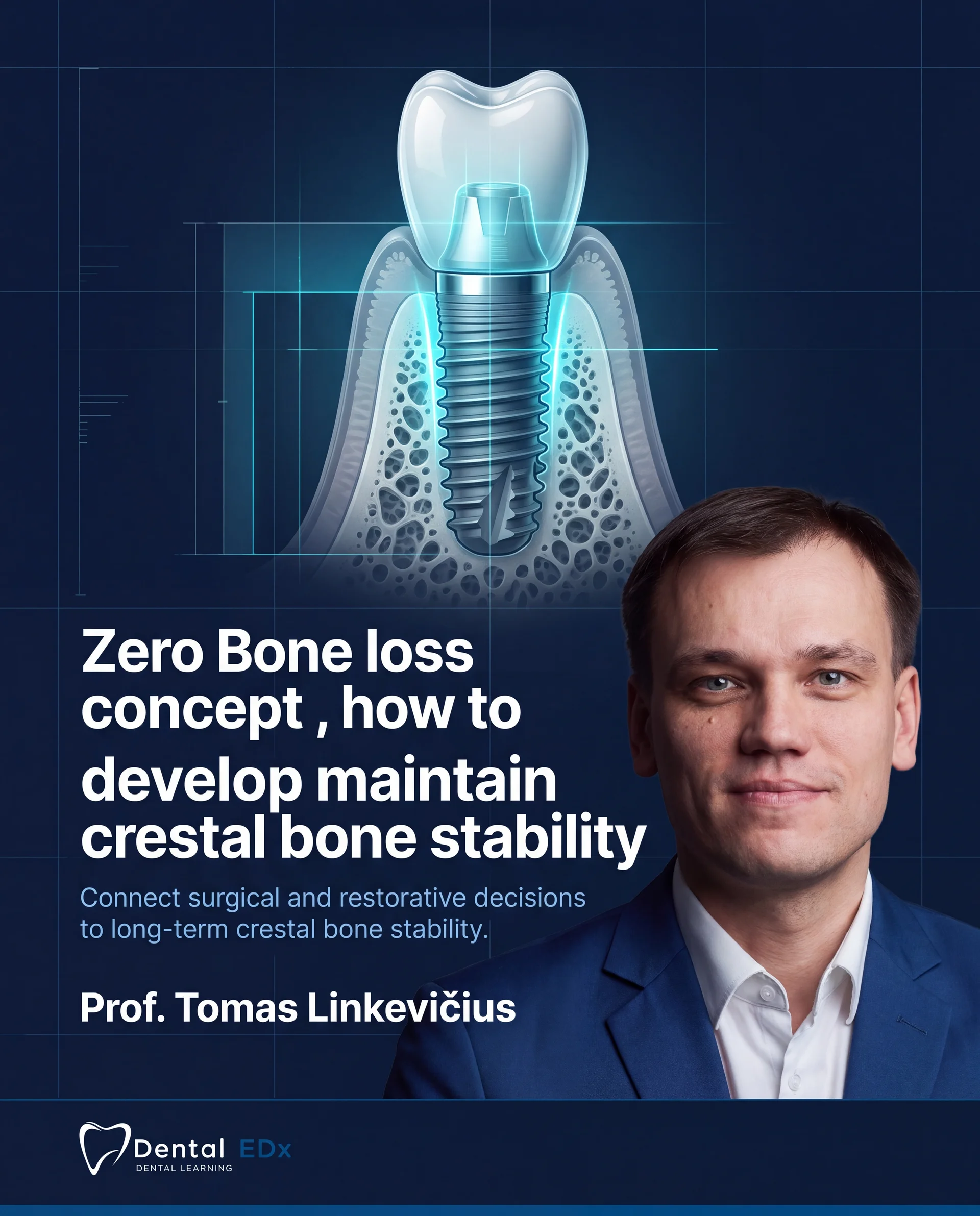
A claim about stable bone needs a starting point and a time interval. When studying crestal bone concepts, ask how the comparison was made and which clinical observations accompany it, rather than treating a course name as a guaranteed outcome.
CLINICAL TAKEAWAY
What matters most
- Identify baseline and follow-up dates.
- Separate observation from causation.
- Avoid guaranteeing bone-level outcomes.
EVIDENCE LENS
The AO/AAP consensus examines prosthetic and biological factors associated with peri-implant conditions, supporting a broader review than radiographic appearance alone.
Establish the baseline
Identify the date and purpose of each record in a case presentation. Note whether the images are comparable and what the author actually measured. A visual impression of similarity is not the same as a documented longitudinal assessment.
Read the prosthetic and tissue context
Ask how the restoration, soft tissues and follow-up findings are described. Keep observations separate from explanations: a case may show a change without proving a single cause. This distinction is especially important when several treatment decisions were made together.
Build a useful review habit
For each case, summarize the baseline, the observation period, reported findings and unresolved questions. Revisit the same format across multiple cases. It helps reveal whether the teaching offers a reproducible way to evaluate patients or relies mainly on selected favorable examples.
A stable image needs a comparable baseline
Radiographic claims are meaningful only when timing, projection and measurement are described. A visually similar image pair cannot establish stability if the records were not created and interpreted in a comparable way.
Separate associated design choices from proven causes
Implant depth, tissue thickness, connection, restoration and maintenance may appear together in a successful case. The observation does not isolate which element produced the outcome. Teaching should preserve that distinction between a concept and causal evidence.
Turn the topic into a structured team review
Choose one de-identified case that raises the question of crestal bone preservation. Review it in stages rather than jumping to the final image: define the patient-centered objective, list the available records, identify who made each decision and mark every assumption or missing item. Then compare the sequence with the cited evidence and the applicable manufacturer or professional guidance. The objective is to understand why this pathway was selected, not to reproduce a technique from an article.
Repeat the review after delivery or follow-up and ask what the team would change. Use these checkpoints: Identify baseline and follow-up dates. Separate observation from causation. Avoid guaranteeing bone-level outcomes. Record disagreements between the clinical, technical and maintenance perspectives instead of forcing an immediate consensus. A short, documented calibration exercise makes the article useful to the whole team and creates questions that can be taken into formal education, mentoring or supervised practice.
TAKE INTO YOUR NEXT CASE DISCUSSION
Three points to keep in view
- Identify baseline and follow-up dates.
- Separate observation from causation.
- Avoid guaranteeing bone-level outcomes.
Evidence & references
The AO/AAP consensus examines prosthetic and biological factors associated with peri-implant conditions, supporting a broader review than radiographic appearance alone.
- AO/AAP consensus on prevention and management of peri-implant diseases and conditions (2025) Wang et al. · Journal of Periodontology
References support the evidence discussion, not an endorsement of DentalEDX. Practical study prompts are editorial suggestions. No patient outcomes or professional accreditation are promised.
A common question
Does “zero bone loss” guarantee an individual result?
No. A course concept or title is not an individual clinical guarantee.
CONTINUE LEARNING
Explore this topic in more depth.
Review the curriculum and prerequisites to choose teaching that fits your experience.