Educational scope. This article supports professional learning and case discussion. It is not patient-specific advice, a clinical protocol or a substitute for supervised training.
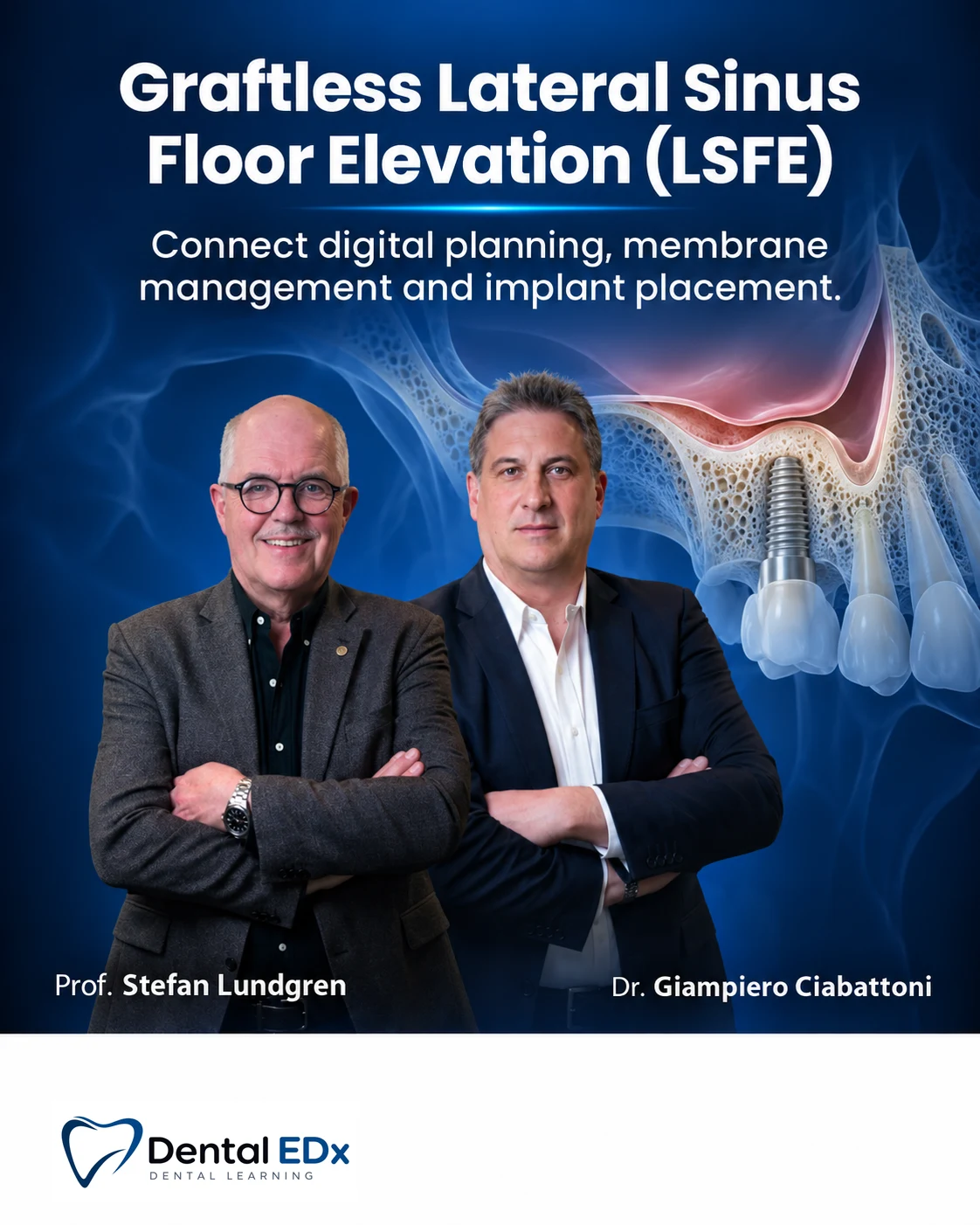
“Graftless” describes an aspect of a technique; it is not a guarantee of lower risk or a universal treatment indication. When reviewing this subject, start by defining exactly which intervention and patient population the educational material discusses.
CLINICAL TAKEAWAY
What matters most
- Define the exact intervention.
- Avoid borrowing conclusions from a different procedure.
- Examine follow-up and exclusions.
EVIDENCE LENS
The short-implant randomized trial is useful comparison literature, but it is not direct evidence for every graftless sinus protocol.
Keep neighboring procedures separate
A study comparing short implants with sinus augmentation does not automatically validate a graftless lateral approach. These are different questions. Write the intervention, comparator and outcome in plain language before using a paper to support a statement.
Look for selection and follow-up
Ask which site characteristics were required, what would have excluded a patient and how results were assessed. Record the length of observation. If those details are absent from a promotional description, look for them in the teaching material and supporting research rather than assuming them.
Make uncertainty part of the learning goal
Prepare questions about complications, alternative plans and the experience required to manage them. A valuable course should help you understand where an approach may fit and where its evidence or your own competence is insufficient. Do not translate the absence of a graft into the absence of surgical complexity.
Define what “graftless” actually describes
The label may refer to a specific aspect of a sinus-elevation protocol, not the absence of surgery, risk or anatomical constraints. Readers should identify the access approach, stabilization concept, population and follow-up before comparing it with another technique.
Avoid evidence borrowed from a neighboring procedure
Research on short implants, transcrestal elevation or grafted lateral windows may inform the broader discussion but does not directly validate every graftless protocol. State the intervention and comparator in plain language before drawing a conclusion.
Turn the topic into a structured team review
Choose one de-identified case that raises the question of graftless sinus elevation. Review it in stages rather than jumping to the final image: define the patient-centered objective, list the available records, identify who made each decision and mark every assumption or missing item. Then compare the sequence with the cited evidence and the applicable manufacturer or professional guidance. The objective is to understand why this pathway was selected, not to reproduce a technique from an article.
Repeat the review after delivery or follow-up and ask what the team would change. Use these checkpoints: Define the exact intervention. Avoid borrowing conclusions from a different procedure. Examine follow-up and exclusions. Record disagreements between the clinical, technical and maintenance perspectives instead of forcing an immediate consensus. A short, documented calibration exercise makes the article useful to the whole team and creates questions that can be taken into formal education, mentoring or supervised practice.
TAKE INTO YOUR NEXT CASE DISCUSSION
Three points to keep in view
- Define the exact intervention.
- Avoid borrowing conclusions from a different procedure.
- Examine follow-up and exclusions.
Evidence & references
The short-implant randomized trial is useful comparison literature, but it is not direct evidence for every graftless sinus protocol.
- Short implants versus longer implants with sinus floor elevation: three-year randomized trial (2017) Pohl et al. · Journal of Clinical Periodontology
References support the evidence discussion, not an endorsement of DentalEDX. Practical study prompts are editorial suggestions. No patient outcomes or professional accreditation are promised.
A common question
Does “graftless” mean there is no surgical risk?
No. The name does not remove the need for anatomical assessment, appropriate training and complication planning.
CONTINUE LEARNING
Explore this topic in more depth.
Review the curriculum and prerequisites to choose teaching that fits your experience.