Educational scope. This article supports professional learning and case discussion. It is not patient-specific advice, a clinical protocol or a substitute for supervised training.
Photogrammetry and intraoral scanning are often presented as competing ways to record a complete arch, but they may capture different information and occupy different places in a workflow. The comparison should begin with the required record, not the novelty of the device.
CLINICAL TAKEAWAY
What matters most
- Define the required record.
- Check clinical versus laboratory evidence.
- Verify component compatibility.
EVIDENCE LENS
A 2025 systematic review reported accuracy advantages for photogrammetry in included comparisons while noting that much of the evidence was in vitro.
Define the information being captured
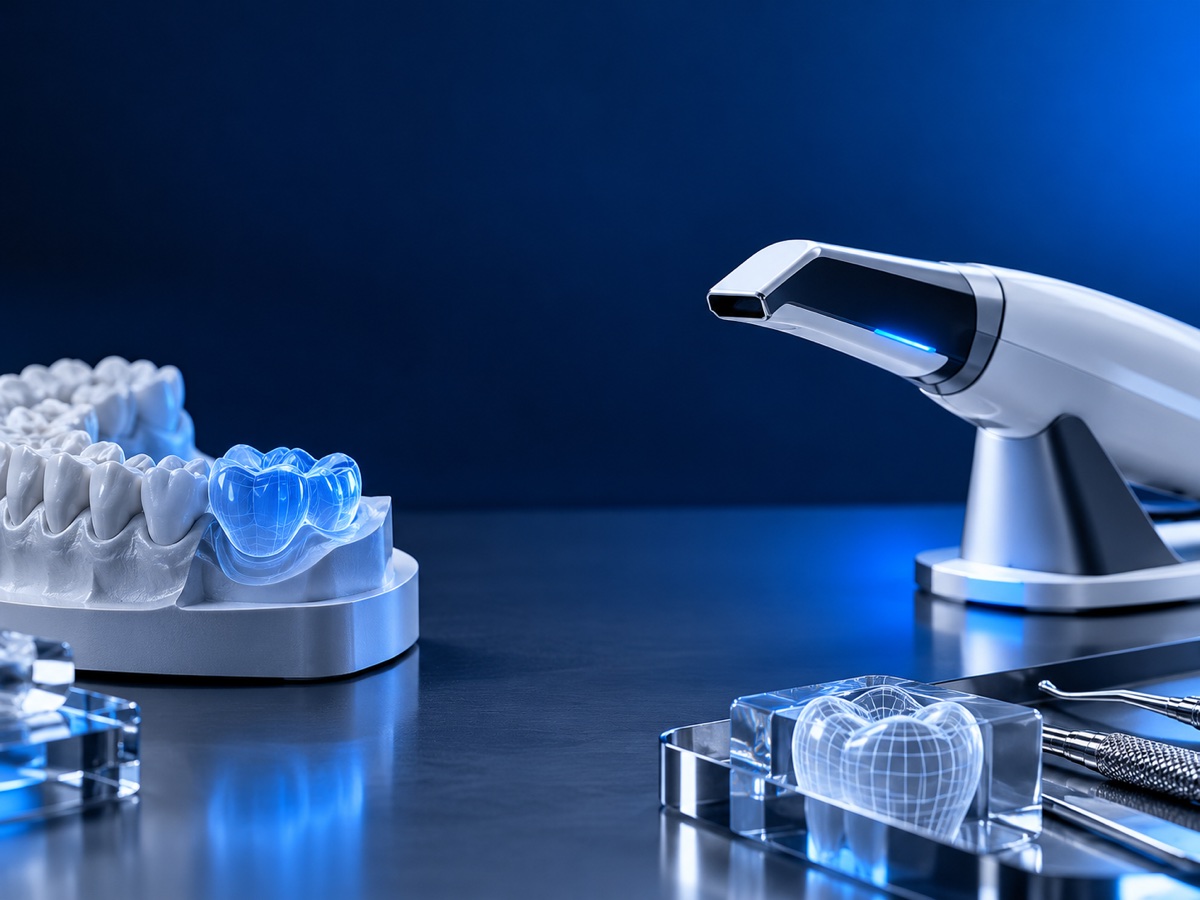
Photogrammetry systems focus on the spatial relationship of implant components. Intraoral scanners can capture broader surface anatomy. A workflow may still need both geometry and soft-tissue or prosthetic information.
Read the study environment
Many accuracy studies are laboratory based. Check whether movement, saliva, access, implant depth and other clinical variables were represented before transferring the result to patients.
Account for the library and components
The relationship among scan bodies, photogrammetry components, implant libraries and the CAD system is part of the information chain. Compatibility does not replace verification.
Keep a clinical confirmation step
The final record should be evaluated within the selected restorative protocol. No acquisition technology makes passive fit or delivery quality automatic.
Plan for the records that neither technology supplies alone
Implant coordinates may still need soft-tissue contours, opposing anatomy, interarch relationships, facially oriented records and a restorative prescription. Map which device captures each record and how the data sets are aligned before assuming that one acquisition replaces the other.
The integration step deserves its own verification. Confirm coordinate systems, component libraries and alignment references, then review the combined model against the provisional or existing prosthesis when appropriate. A precise data set can still be combined incorrectly.
Turn the topic into a structured team review
Choose one de-identified case that raises the question of dental photogrammetry vs intraoral scanner. Review it in stages rather than jumping to the final image: define the patient-centered objective, list the available records, identify who made each decision and mark every assumption or missing item. Then compare the sequence with the cited evidence and the applicable manufacturer or professional guidance. The objective is to understand why this pathway was selected, not to reproduce a technique from an article.
Repeat the review after delivery or follow-up and ask what the team would change. Use these checkpoints: Define the required record. Check clinical versus laboratory evidence. Verify component compatibility. Retain restorative confirmation. Record disagreements between the clinical, technical and maintenance perspectives instead of forcing an immediate consensus. A short, documented calibration exercise makes the article useful to the whole team and creates questions that can be taken into formal education, mentoring or supervised practice.
TAKE INTO YOUR NEXT CASE DISCUSSION
Three points to keep in view
- Define the required record.
- Check clinical versus laboratory evidence.
- Verify component compatibility.
- Retain restorative confirmation.
Evidence & references
A 2025 systematic review reported accuracy advantages for photogrammetry in included comparisons while noting that much of the evidence was in vitro.
- Photogrammetry versus intraoral scanning in complete-arch implant impressions (2025) Systematic review and meta-analysis · PubMed
References support the evidence discussion, not an endorsement of DentalEDX. Practical study prompts are editorial suggestions. No patient outcomes or professional accreditation are promised.
A common question
Does photogrammetry replace an intraoral scan in every full-arch case?
No. The required soft-tissue, prosthetic and implant-position records depend on the workflow.
CONTINUE LEARNING
Explore this topic in more depth.
Review the curriculum and prerequisites to choose teaching that fits your experience.